

THE OLD BOROUGH OF WAYNESBORO, PENNSYLVANIA (USA)
The small town of Waynesboro was founded in 1794 by Scotsman John Wallace; he first called his 633 acres land, Mount Vernon, later the Borough was renamed Wallace Town and finally Waynesboro. The Borough of Waynesboro has today approximately 11,000 inhabitants. Situated about 2 miles north of the Mason-Dixon line, it is fairly close to Baltimore (MD), Harrisburg (PA) and to the U.S. capital of Washington D.C. Waynesboro became of historic importance especially during the first stages of the Confederates’ Gettysburg Campaign and during the Confederates’ Retreat between June and July 1863. In the nearby Chambersburg, shredded fermented cabbage became especially known when General Robert E. Lee asked the locals to provide his Confederate soldiers with 25 barrels of “Saur-Kraut” (On Food and Cooking by H. McGee; first revised edition 2004 by Scribner).

As a town of passage, located between Pennsylvania and Maryland in Franklin County, Waynesboro in Pennsylvania, gained again notoriety because of its vicinity to Blue Ridge Summit Resort where socialite Bessie Wallis Warfield had been born in 1896. Known later simply as Wallis Simpson, the American “Duchess” became renown for being married three times, twice divorced, and later married to Prince Edward, Duke of Windsor (former King Edward VIII), who abdicated the British throne in 1936 to marry her.

ABOUT SAUERKRAUT, ALSO CALLED “KRUT”, SAUERKOHLE OR SOUR CABBAGE
“Sauerkraut,” also known as “Sauerkohle,” “Sour Cabbage,” or “Sauerkraut,” brought first to Europe presumably from China, became an in-salt-preserved staple food in Germanic Europe especially after the XII century; in fact, Sauerkraut, called “Krut,” was mentioned in 1282 by German poet Meier Helmbrecht as a delicious food prepared with “Weisskohl” or “Spitzkohl” and was especially liked if served with good meat.
Old German text: “…ein krut wil kleine gesnitzen, veizt und mager, in beden siten, ein guot fleisch lac da bi…” [Text: Meier Helmbrecht; Hrsg. F. Panzer, Halle 1902 u. Oe. Faksimile Internet Archive – Das puech ist von dem Mayr Helmsprechte; vor 1282 – hs.augsburg.de].
Translation: [the green] wants to be white and lean and carved [shredded] and set [in brine] with good meat…
HOW TO MAKE SAUERKRAUT FROM SCRATCH
Take green cabbage and salt. Shred the fresh “greens” into 1 mm shreds and mix the cabbage shreds with salt. Fill a large jar with the salted cabbage shreds, weigh down the whole with suitably large clean flat stone and cover the cabbage mixture and the jar with plastic wrap and a lid. Let the covered “sauerkraut” ferment for 1 to 6 weeks at a room temperature (64-76 degrees F [18-24 C]).
OR
Slice thinly or shred a 2 lb. fresh green cabbage and add to it 1-2 Tbsp. salt (approximately 20-40 g); place the whole mixture in a glass jar weighted down under its salt brine. Ferment at room temperature for 4-10 days.
AND
CHRIS THE MAIL LADY’S GRANDMOTHER’S RECIPE FOR SAUERKRAUT AND PORK SHOULDER ROAST (shared by food stylist Lisa Cherkasky and Skutley, Mary Lynn; written down on 10/28/04 during a past Octoberfest):
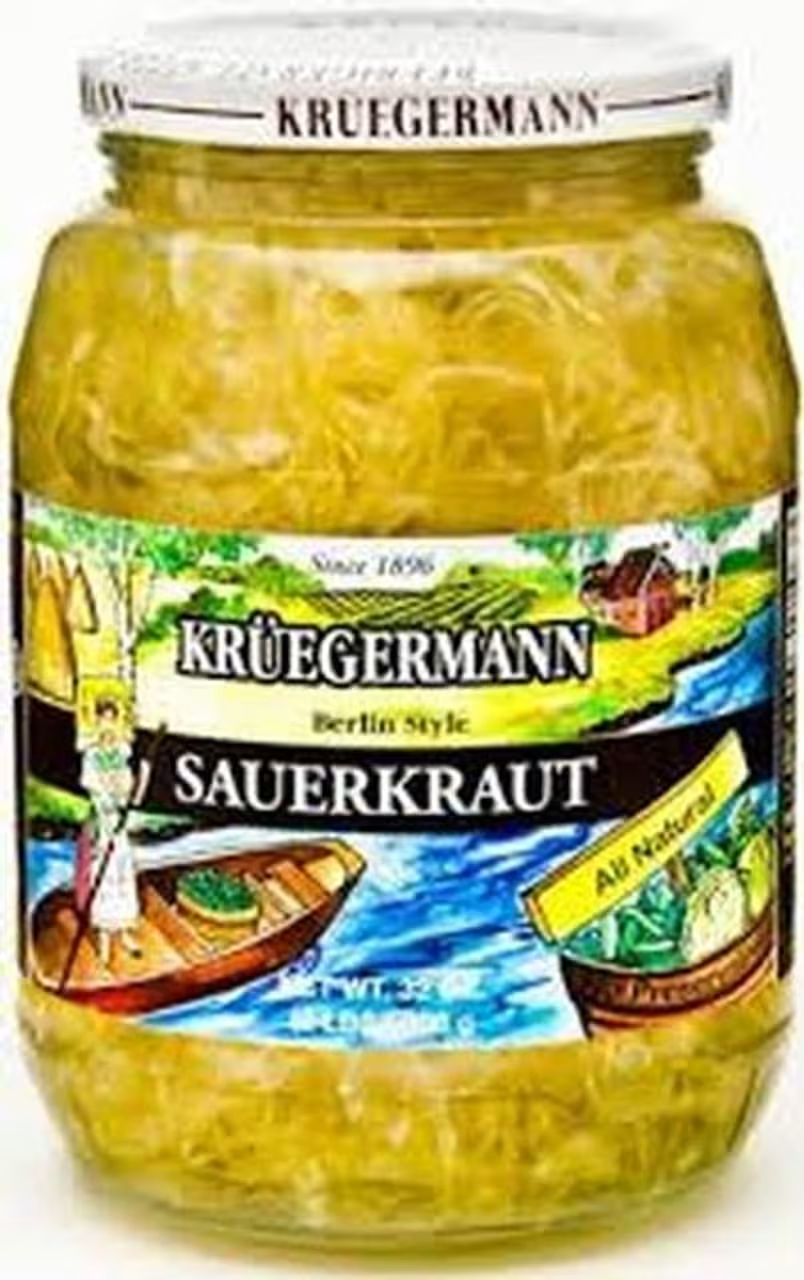
2 pounds of Sauerkraut (best if it’s a German brand), 1 large pork shoulder roast, 3 large apples (finely chopped or grated), 1 large onion, (peeled, finely chopped), 1 1/2 cups of water or white wine, 1-1/2 Tbsp. caraway seeds, 1 raw potato (peeled and finely grated) and 8-10 juniper berries (optional).
Mix all ingredients (kraut, apples, onion, water or white wine, caraway seeds and juniper berries) without the meat and the potato, in a large pot. Nestle the meat into the sauerkraut and set everything over high hear for 5 minutes. Lower the heat and stir; simmer meat and sauerkraut for about 1 1/2 – 2 1/2 hours, stirring and testing occasionally the doness of the meat. The meat will be ready when tender and when it almost falls apart. When the meat is ready remove it and add to the sauerkraut the raw grated potato. Stir and cook for additional 3-5 minutes until the mixture thickens. Serve the Sauerkraut with the sliced pork roast. Optionally: You may serve this specialty with mashed potatoes, mustard, and…a tad of beer. And…Guten Appetit or Mahlzeit!
“WIDOW BOLDE’S” SAUERKRAUT AND MAX AND MORITZ‘S – FIRST AND SECOND NAUGHTY PRANKS: German Sauerkraut, also called “Weisskohl” or “Spitzkohl” or “Sauerkohl” gained especially popularity among German children readers when German writer and illustrator Wilhelm Busch mentioned “Witwe Bolde’s Sauerkohl” in his 1865 “Max und Moritz” naughty children story book.
MAX UND MORITZ EINE BUBENGESCHICHTE IN SIEBEN STREICHEN von Wilhelm Busch – 1906, München, Verlag von Braun und Schneider; Germany; The Project Gutenberg eBook [Max and Moritz, a story of rascals in seven prank episodes by Wilhelm Busch].
VORWORT – PREFACE:
Ach, was muß man oft von bösen
Kindern hören oder lesen!
Wie zum Beispiel hier von diesen,
Welche Max und Moritz hießen.
Die, anstatt durch weise Lehren
Sich zum Guten zu bekehren,
Oftmals noch darüber lachten
Und sich heimlich lustig machten. —
— Ja, zur Übeltätigkeit…
Short translation and adaptation of the verse: It’s too bad that sometimes we are made to hear or read of naughty boys, such as Max and Moritz, who instead of engaging in good things busy themselves in being naught…
ERSTER STREICH – FIRST PRANK EPISODE:
Mancher gibt sich viele Müh’
Mit dem lieben Federvieh;
Einesteils der Eier wegen,
Welche diese Vögel legen,
Zweitens: Weil man dann und wann
Einen Braten essen kann;
Drittens aber nimmt man auch
Ihre Federn zum Gebrauch
In die Kissen und die Pfühle,
Denn man liegt nicht gerne kühle. —
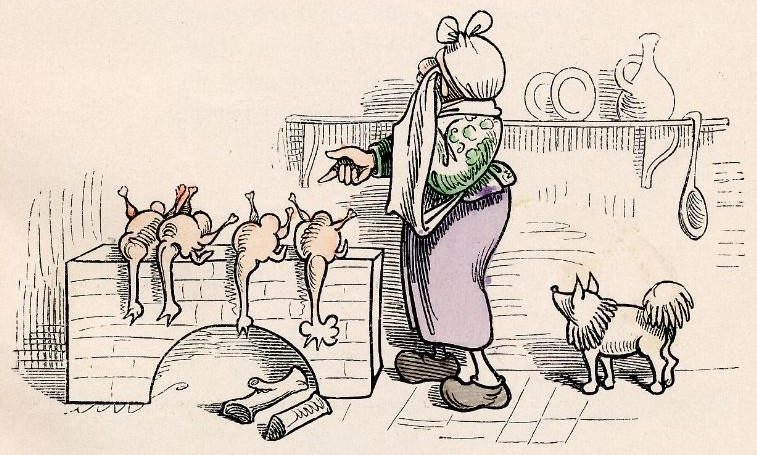
Seht, da ist die Witwe Bolte,
Die das auch nicht gerne wollte.
Short translation and adaptation of the verse: Sometimes people dedicate a lot of time and attention to taking care of those beloved feathered creatures especially for their eggs, for their roasted meat, and for the feathers used in cushions and pillows. Such was the case “Witwe Bolde” (Widow Bolde) who cared very much about her chickens and her rooster.

Ihre Hühner waren drei
Und ein stolzer Hahn dabei. —
Max und Moritz dachten nun:
Was ist hier jetzt wohl zu tun? —
— Ganz geschwinde, eins, zwei, drei
Schneiden sie sich Brot entzwei,
In vier Teile jedes Stück
Wie ein kleiner Finger dick.
Diese binden sie an Fäden,
Übers Kreuz, ein Stück an jeden…
Short translation and adaptation of the verse: Her chickens were three, plus a proud rooster. When Max and Moritz noticed them they thought: What could we do to play a trick on the widow? They decided to cut small finger long pieces of bread and attached them to a cross of strings.
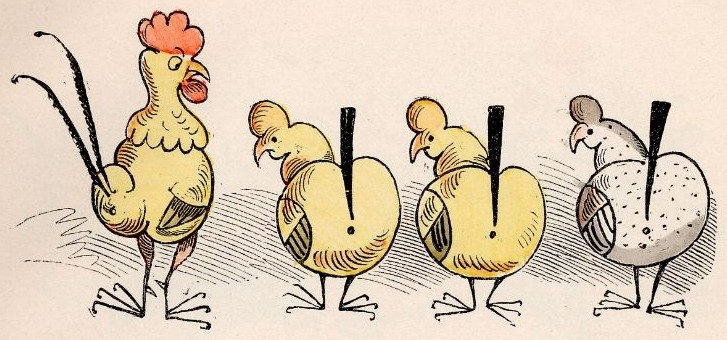
Diese binden sie an Fäden,
Übers Kreuz, ein Stück an jeden, Und verlegen sie genau
In den Hof der guten Frau.
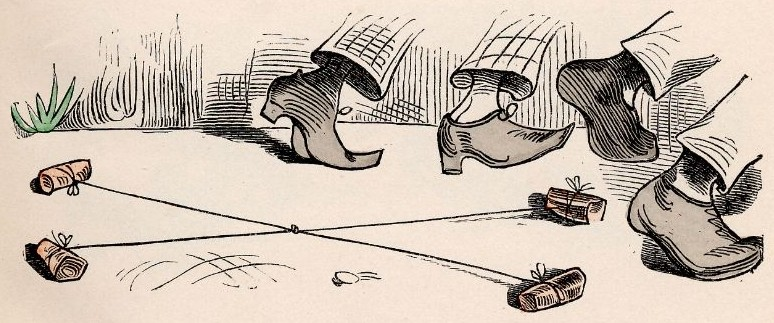
Kaum hat dies der Hahn gesehen,
Fängt er auch schon an zu krähen:
Kikeriki! Kikikerikih!!
Tak, tak, tak! — da kommen sie. Hahn und Hühner schlucken munter
Jedes ein Stück Brot hinunter; Aber als sie sich besinnen,
Konnte keines recht von hinnen. In die Kreuz und in die Quer
Reißen sie sich hin und her, Flattern auf und in die Höh’,
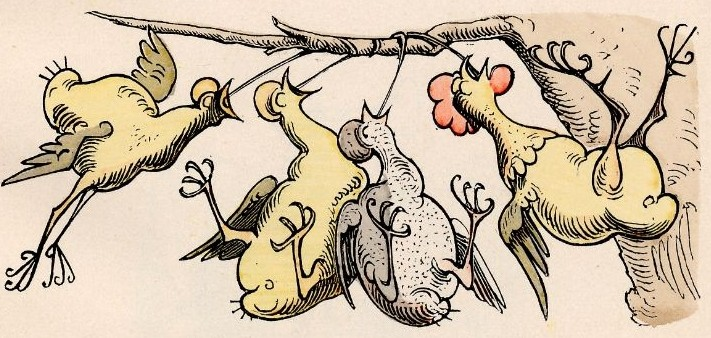
Ach herje, herjemineh! Ach, sie bleiben an dem langen,
Dürren Ast des Baumes hangen. Und ihr Hals wird lang und länger,
Ihr Gesang wird bang und bänger. Jedes legt noch schnell ein Ei,
Und dann kommt der Tod herbei.
Short translation and adaptation of the verse: As soon as the rooster saw what they had done it began to call: Kikiriki! Kikikerikih! And there, the three chickens came eagerly and fed on the pieces of bread attached to the cross tied string. What a terrible shame! When the feathered creatures tried to pull themselves off the string, they pulled and pulled, their neck grew long and longer, and in the effort the laid a final egg and died.
Witwe Bolte in der Kammer
Hört im Bette diesen Jammer: Ahnungsvoll tritt sie heraus,
Ach, was war das für ein Graus! »Fließet aus dem Aug’, ihr Tränen!
All’ mein Hoffen, all’ mein Sehnen,
Meines Lebens schönster Traum
Hängt an diesem Apfelbaum!« …
Short translation and adaptation of the verse: When Witwe Bolde heard the calling, chocking and crowing of her dream chicken from her bedroom window it was too late; with horror and tears in her eyes she saw the creatures hanging off a branch of the apple tree.
ZWEITER STREICH – SECOND PRANK EPISODE:
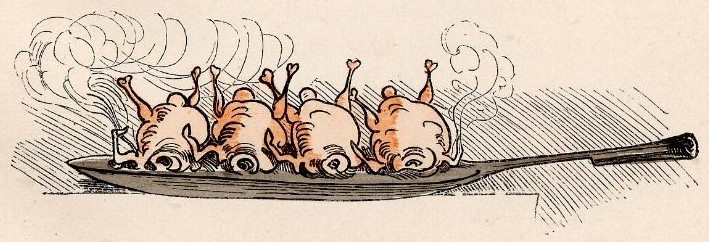
Durch den Schornstein mit Vergnügen
Sehen sie [Max und Moritz] die Hühner liegen,
Die schon ohne Kopf und Gurgeln
Lieblich in der Pfanne schmurgeln. Eben geht mit einem Teller
Witwe Bolte in den Keller, Daß sie von dem Sauerkohle
Short translation and adaptation of the verse: After placing the naked birds on a frying pan set over her stove, “Witwe Bolde” went down her root cellar to fetch from a barrel a portion of her beloved “Sauerkraut” to add to her fried chickens.

Eine Portion sich hole, Wofür sie besonders schwärmt,
Wenn er wieder aufgewärmt. Unterdessen auf dem Dache
Ist man tätig bei der Sache. Max hat schon mit Vorbedacht
Eine Angel mitgebracht. Schnupdiwup! da wird nach oben
Schon ein Huhn heraufgehoben; Schnupdiwup! Jetzt Numro zwei; Schnupdiwup! Jetzt Numro drei; Und jetzt kommt noch Numro vier: Schnupdiwup! Dich haben wir! …
Short translation and adaptation of the verse: While the good “Witwe Bolde” ladled her sauerkraut out the barrel, from above the house’s roof the two naughty rascals were already in action. Max had brought a fishing pole with which, one, two, three and four the fried chicken were lifted up through the chimney and disappeared with the rascals.
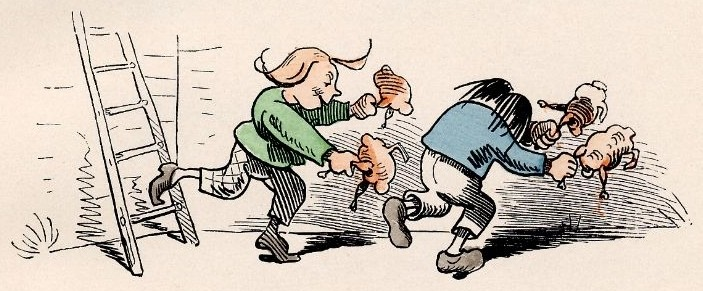

Max und Moritz im Verstecke, Schnarchen aber an der Hecke, Und vom ganzen Hühnerschmaus Guckt nur noch ein Bein heraus…[und die gute Witwe Bolde weint noch immer nach der Beute der zwei Buben…].
Translation and adaptation of the verse: In their hiding place, while the poor widow cried missing her dinner, Max and Moritz very satisfied, ate her fried chickens leaving behind only one drumstick each…
Do you wish to know how the story ended? Witwe Bolde blamed her little dog for eating the chickens; the boys run away to their next naughty endeavor…however, in the end Max and Moritz were punished!!! (see: the final sixth and seventh prank they tried to play around farmer Mecke and miller master Mueller!… and all the pranks published in several book-story versions throughout the world!)
TO CAKE OR NOT TO CAKE WITH SAUERKRAUT ? YES TO HEIDI’S DELICIOUS CHOCOLATE GANACHE SAUERKRAUT CAKE!
Sauerkraut cake? Yes!!
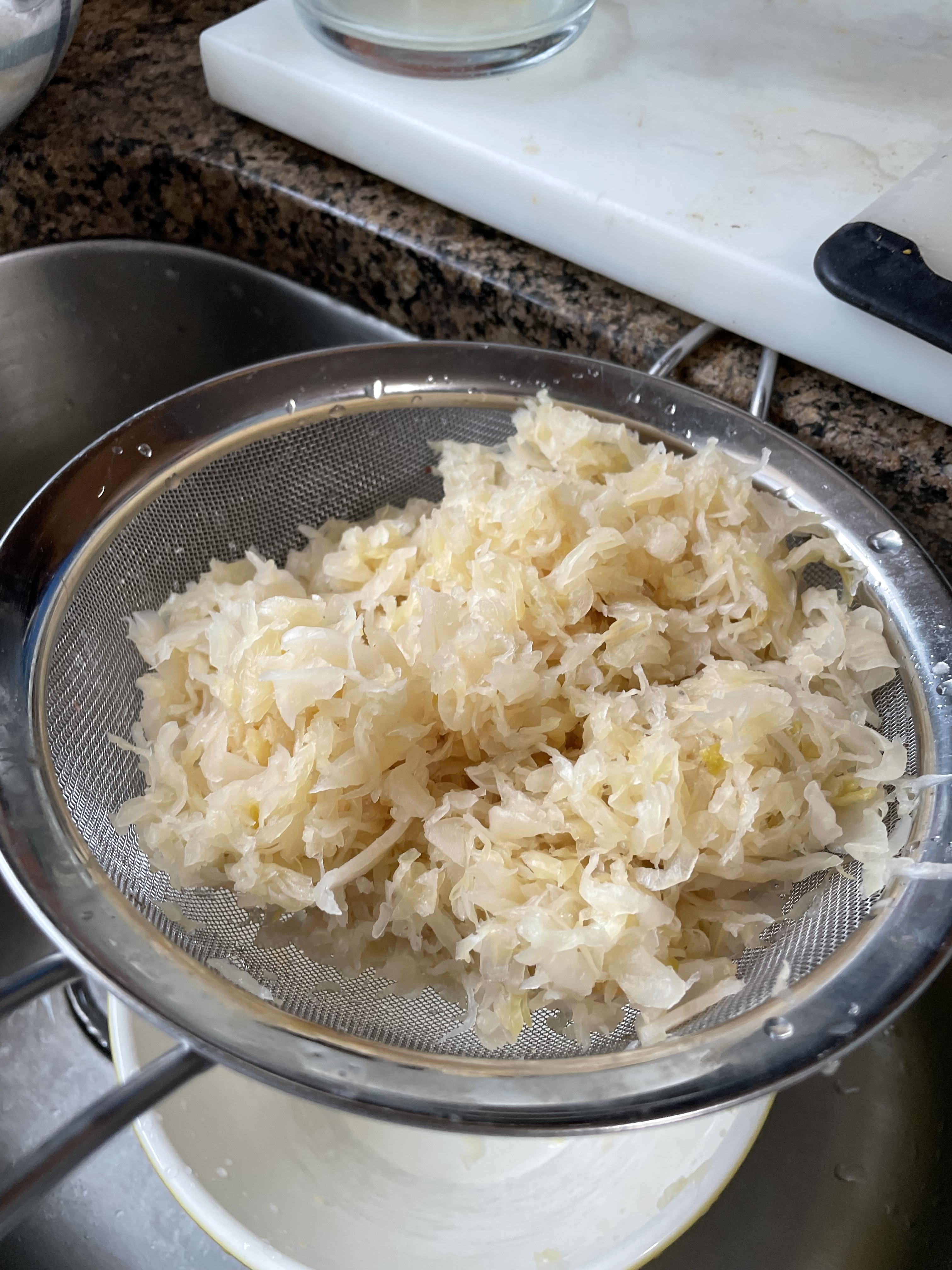
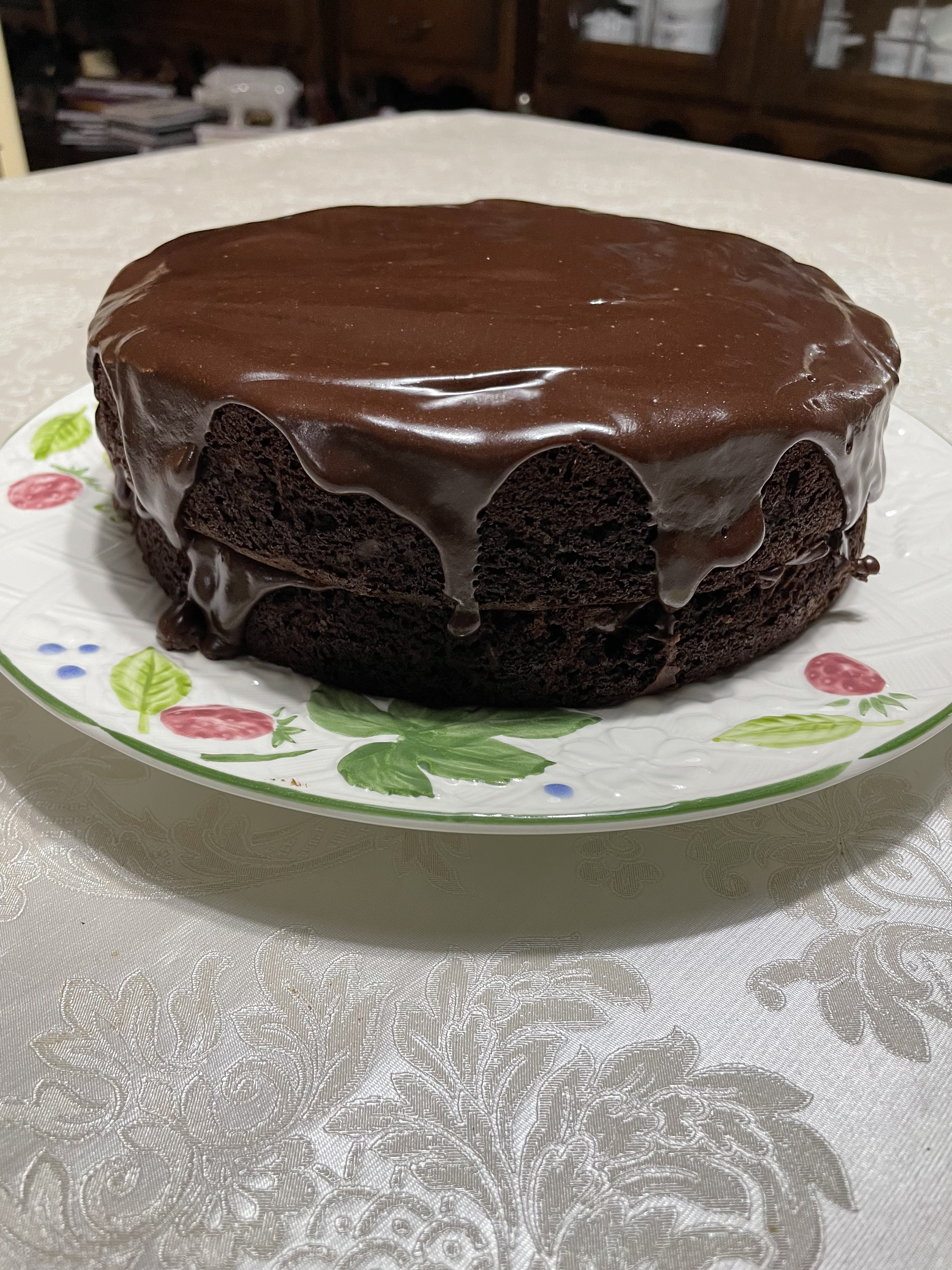
Delicious, moist, dark, sweet, chocolaty, with a texture which reminds of coconut! And…yes, now and then…as international food-history unfolds, one may discover by share coincidence, a home-baker’s masterpiece which not only reflects baking expertise and creativity, but also the “multi ethnic cuisine and culture” of America. I tasted the chocolate ganache sauerkraut cake and watched my friend Heidi baking the cake in her kitchen in Waynesboro, Pennsylvania.
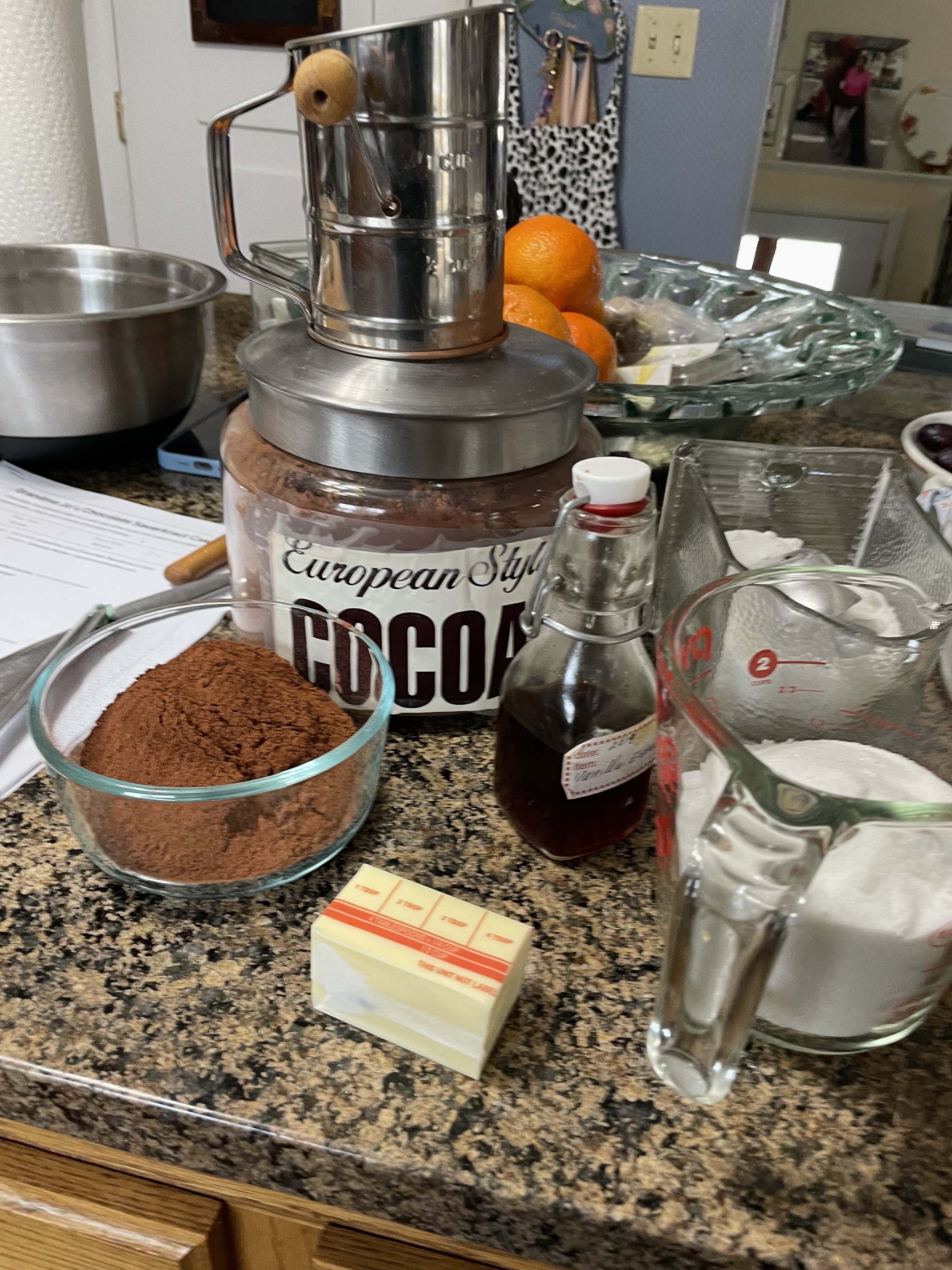
INGREDIENTS FOR PREPARING HEIDI’S CHOCOLATE GANACHE SAUERKRAUT CAKE (makes an 8 inch round cake):
1/4 cup (1/2 stick or 57-60 g) unsalted butter (at room temperature), 1 1/2 cups (about 300 g) granulated sugar, 3 large eggs, (at room temperature), 1 tsp. vanilla extract, 2 cups (250 g) all purpose flour, 1 tsp. baking powder, 1 tsp. baking soda, 1/4 tsp. kosher salt, 1/2 cup (about 59-60 g) Dutch-processed cocoa powder, 1 cup (250 g) water, 18 oz. (1 1/2 cups) sauerkraut (drained and chopped finely)*.
Preheat the oven to 350 degrees F (180 C) and spray with non-sticking cooking spray a round (9×13 inch) baking pan. In medium mixing bowl, cream butter and sugar (possibly with a hand mixer) until light and fluffy. Add the eggs, one at the time, and the vanilla extract. Mix again on medium speed. In a separate bowl, combine flour, baking powder, baking soda, salt and cacao powder. Mix the flour mixture with the creamed butter sugar mixture and the water (while mixing alternate the various mixtures three times). Fold in the finely chopped and drained sauerkraut and mix gently. Pour the mixture into the prepared baking dish and bake for about 35-40 minutes or until a toothpick comes out clean. Let the cake cool before covering it with the frosting.
HEIDI’S FROSTING FOR HER 8 INCHES ROUND CHOCOLATE GANACHE SAUERKRAUT CAKE:
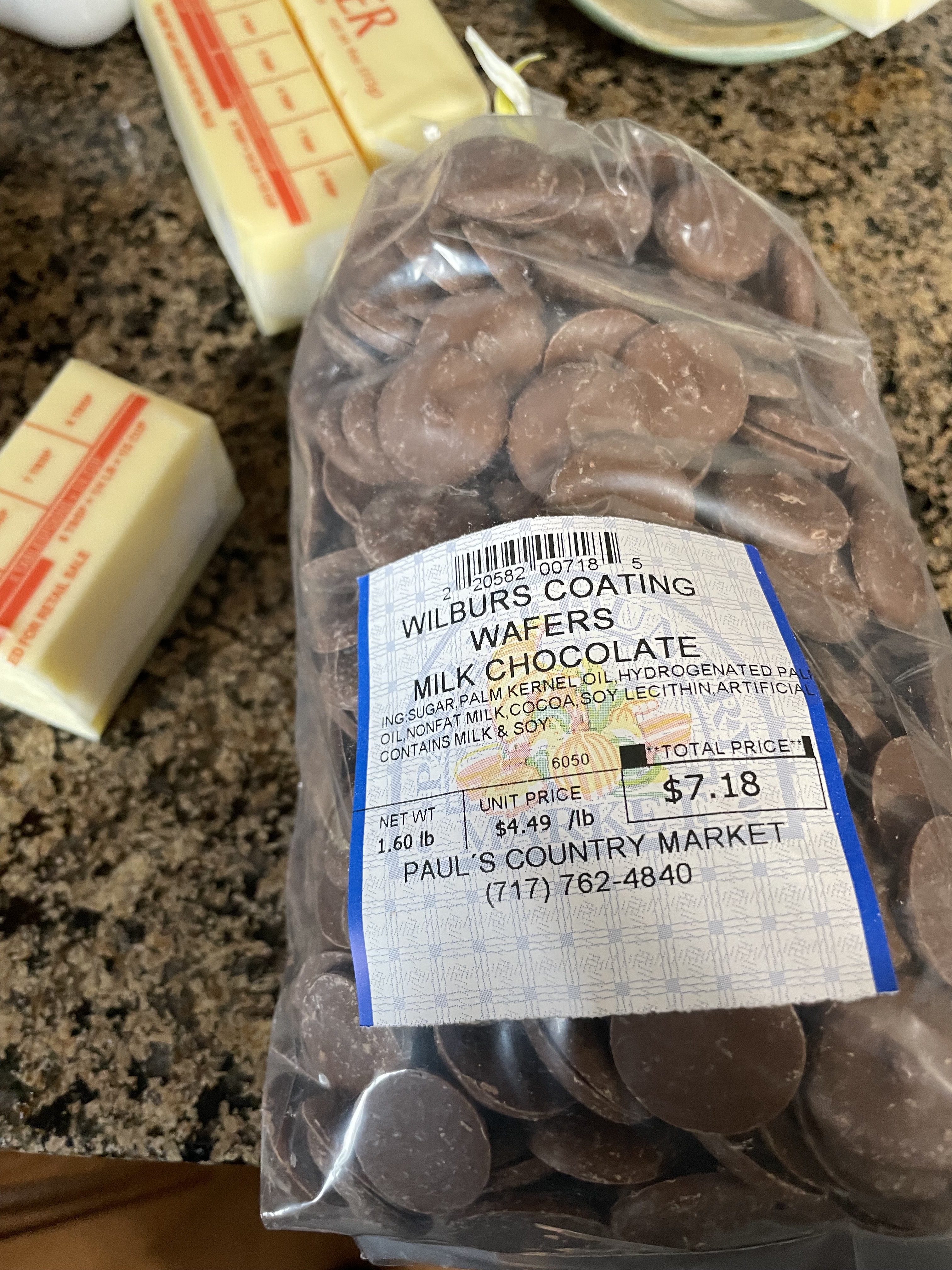
8-10.6 oz. (+ or -300 g) bittersweet chocolate, grated finely; 1/2 cup heavy cream, 1/2 tsp. granulated espresso coffee.
Place your chocolate-cream-coffee mixture in a heat resistant bowl over a pot of boiling water and, whisk and stir all ingredients until obtaining a smooth chocolate cream. To give the frosting a shine while you whisk add a tablespoon of butter. When the frosting is shiny and creamy, pour it gently over the cake and with a spatula distribute the frosting evenly over the surface and the sides of the cake.
INTERESTING BIBLIOGRAPHY AND RESOURCES:
ON FOOD AND COOKING; The Science and Lore of the Kitchen, Completely Revised and Updated by Harold McGee; 1984-2004, Scribner, 1230 Avenue of the Americas, New York, NY 10020
FOOD BOOK by James Trager (with a salute to Mr. Trager by James Beard); 1972 First Flare Printing, Grossman Publishers, Inc. 125 A East 19th Street, New York, N.Y. 10003
MAX AND MORITZ, edited and annotated by H. Arthur Klein and translated by H. Arthur Klein and others. 1962, Dover Publisher; paperback.
MAX & MORITZ BILINGUAL VERSION; 2022, Alfa Veda Verlag; paperback
THE KITCHEN SHOPPE, Inc. and COOKING SCHOOL since 1974; 101 Shady Lane, Carlisle, PA 17013 Tel. (717) 243-0906 or 800-391-2665 – WWW.KITCHENSHOPPE.COM
WILBUR CHOCOLATE Chocolatier; 45 N. Broad Street, Lititz, PA 17543; Store: 1 888 2945287; internet and email: https://www.wilburbuds.com or wilburstore@cargill.com
 CULINARY ROOTS & RECIPES™
Thanks, I always learn so much when I read your culinary blog! And I will definitely try to make this sauerkraut chocolate cake
Bella , curiosa ed interessante. Un abbraccio e grazie Eliseo