

Once every winter, several townships and villages in the Autonomous Region of South Tyrol and Trentino celebrate the ancient winter tradition of Nikolaus and Krampus. The celebration predates the Council of Trento (1545-1563) and probably the very early Crusades when, after 1095 A.D., Christians and Muslims fought over the Holy Land and the Spice Trade. Several Crusades were then blessed by Christian Popes and Bishops before Muslims and Christians came to an agreement over Jerusalem with the famous Egyptian Sultan Saladin.
And as history and legends unfold and shape ancient Christian traditions, in the small town of Branzoll, also called Bronzolo, the Krampus visited last year and will visit again young and old. He has visited and will visit again to celebrate ancient traditions, to amuse, to bemuse, or to possibly scare those who did wrong. During cold Alpine winter evenings and nights, kids can watch him shaking chains and switches from behind their parents’ coats or behind Holy Nikolaus’s mantle.


Urban II and his Christian Crusaders (1088 – 1099)

Muslim Sultan Saladin (1137 -1197)

A Parade with Branzoll’s Devils, also known as Krampus or Tuifl
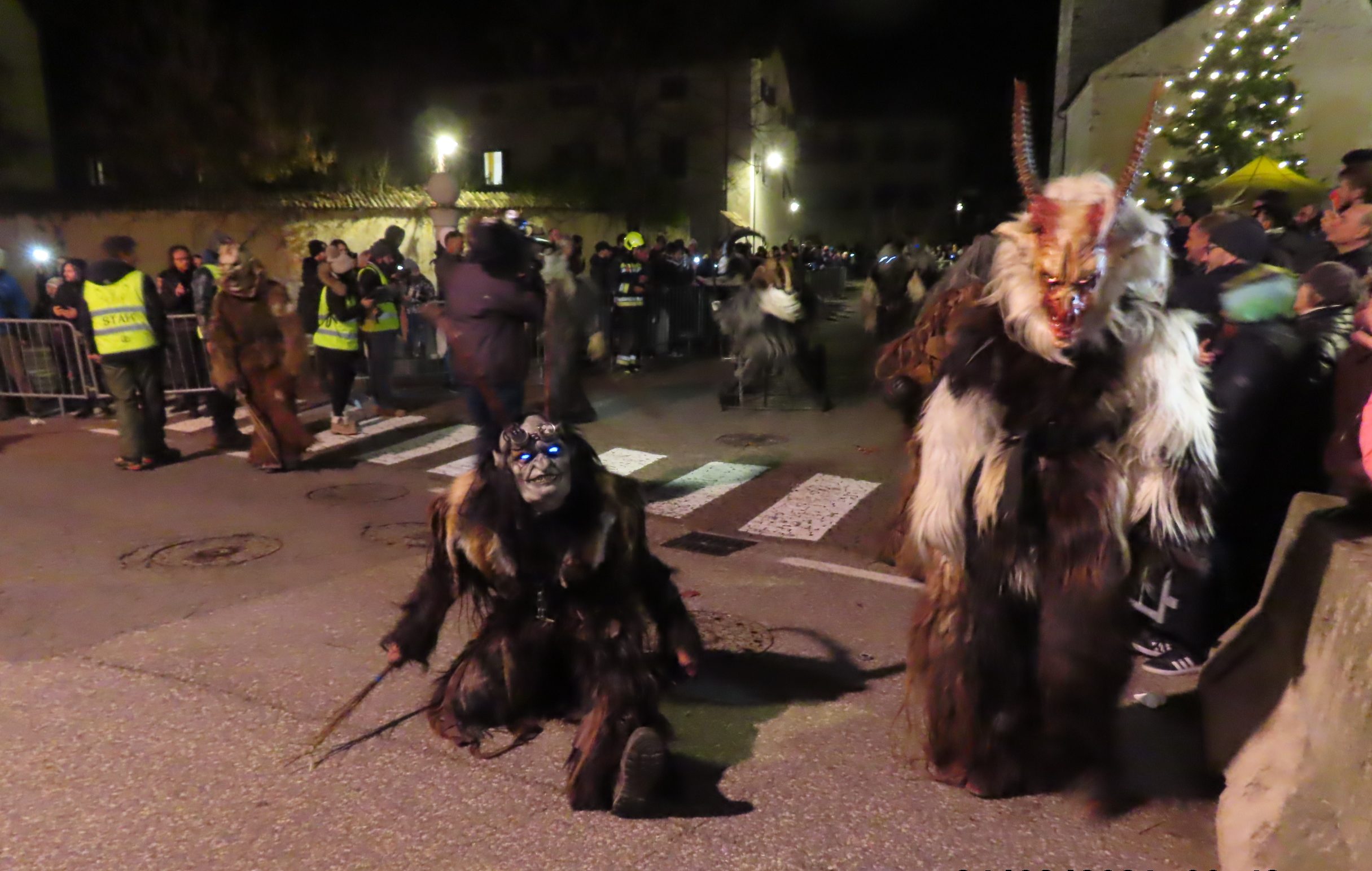
WHO WAS THE SCARY KRAMPUS?
The Germanic Krampus is known also as de Zwarte Piet (Black Peter in Dutch), Knecht Ruprecht (Servant Rupert) in Europe and as the Bellsnickler, the Pelz Nikel, the Black Peter and Krisskringle in North America. The origins of Krampus date back to the Crusades and not to pagan times as some historians have suggested. During the time of the Crusades, Muslim Moors, fighting for Ottoman sultans, aimed to win over Christians. Their goal was to keep the spice routes closed to Westerners and impose a new way to worship God. Over time, Krampus became associated with all that Christians remembered in the name of the Holy Roman Church. He was scary, dark, ugly, and a servant to a Holy Christian Bishop called Saint Nicholas from Myra in Turkey.
AND WHAT ABOUT SAINT NICHOLAS?
There are many versions of legends and stories around Saint Nicholas. One story reports of a Greek Orthodox bishop of Myra, Turkey. He helped the poor and blessed the knights who fought for the conquest of Jerusalem. He gifted unmarried girls to allow them to have a suitable dearie. He became known as a miracle worker before his remains were moved to Bari, Italy, around 808 A.D.

Move from Myra, Turkey to Bari, Italy

SAINT NICHOLAS ARRIVAL TO BARI, ITALY – SAN NICOLA DI BARI
The remains of the holy Saint Nicholas arrived in Italy around 1095. Pope Urban II blessed this event. The important Cathedral of Bari and a gold decorated crypt were built to honor the famous Bishop. From there, knights, travelers, pilgrims and mariners, moved in and out, leaving for the Holy Land, or returning home, if they were lucky. The memory of good old Saint Nicholas moved around. Many Christian fighters traveled north, beyond the Alps. Many more moved east, throughout Ukraine and Russia. They spread the cult of the saintly bishop among young and old.

A Greek Orthodox Bishop comes to town.
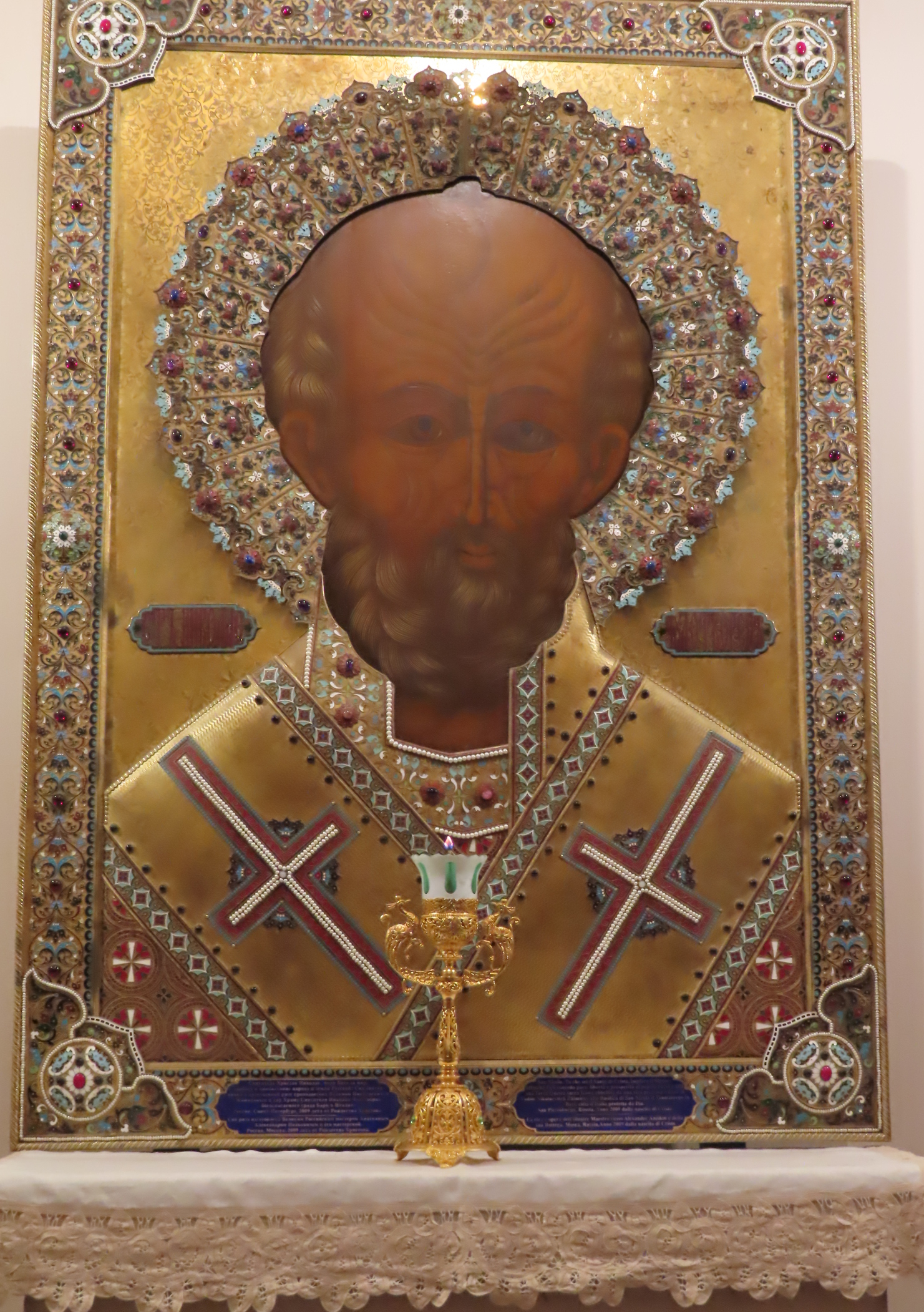
TODAY STILL, IN SOUTH TIROL AND BORDERING AUSTRIA, DER HEILIGE NIKOLAUS

During Pre Christmas season, in South Tirol and bordering Austria, der Heilige Nikolaus and ugly, scary, fury Krampus, make house calls. They carry baskets and bags filled with oranges, persimmons, apples, dried figs, Zelten, and ginger bread cookies. They seem to know who, among the little ones, has learned the multiplication table. They know who has shared with siblings and school friends. They also know who has been naughty and who has been good. How do they know?
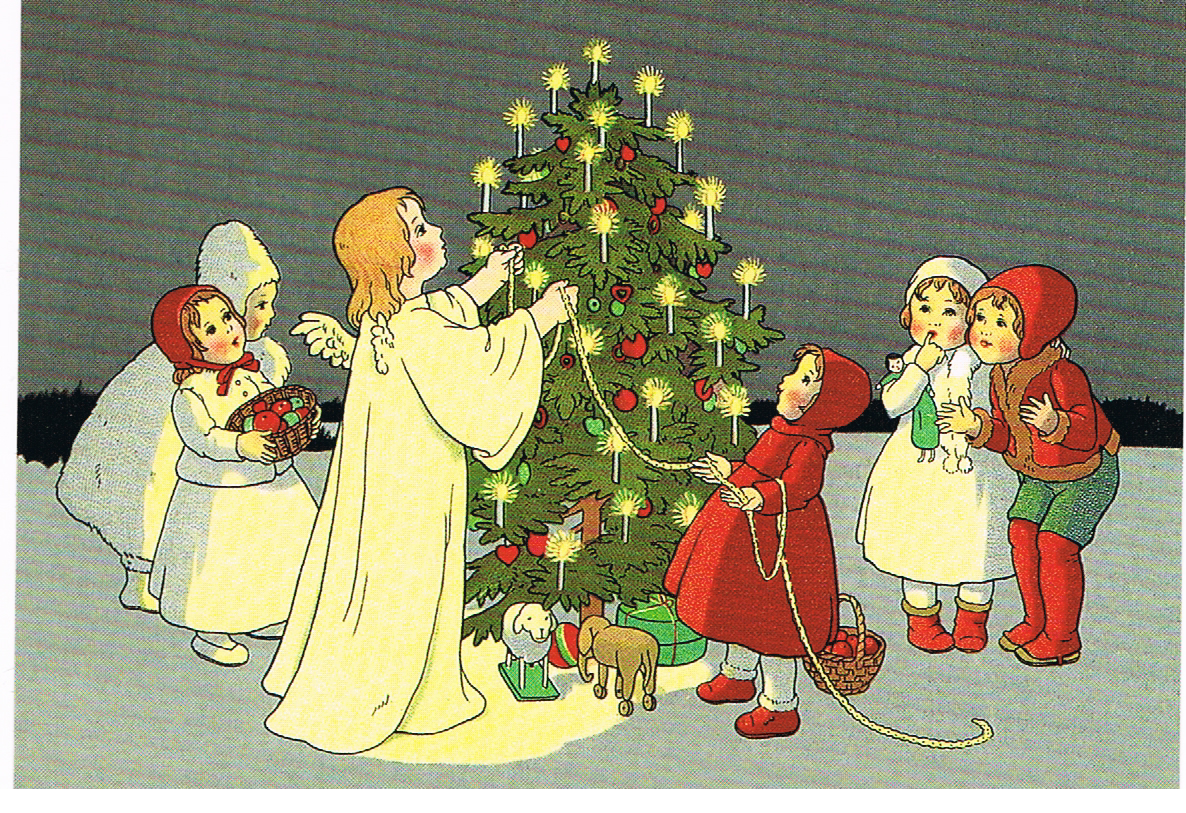
Ask the parents… Krampus hides behind a room’s door. He rattles his chains and beats his switches against the stables’ walls. Good kids might be even allowed to peek in the big Book… Beyond the warm Stube living room’s windows, where the cold wind blows the old wooden stable doors creek and squeak, there is usually the silent and white snow falling before the surrounding fields are ready for Christkindl to fly in with his angels on a sled. During those waiting weeks, before Christmas then, grandmothers, mothers, aunts and local pastry chefs will bake Tyrolean and Trentino’s Zelten.

Two are the popular Zelten prepared throughout South Tirol and Trentino before Christmas Eve. The dark Zelten probably dates back to ancient times. Celtic people used locally grown milled rye and buckwheat, kneaded with pork fat, dried fruit, and nuts. The white, more modern Zelten, dates to a more recent time. During a time, when interregional and international trade routes and wealth allowed the access to more expensive ingredients. These included refined wheat flours, butter fat, yeast, and Mediterranean grown fruits.
RECIPE – HOW TO MAKE A DARK SOUTH TIROLEAN ZELTEN BEFORE CHRISTMAS EVE

1 lb (453 gr) raisins, rinsed, 1 lb (453 gr) butter, 1 cup (200 gr) pitted and chopped dates, 1 cup (200 gr) dried, cored, chopped pears, 1 1/4 cups (250 gr) chopped walnuts, 1 cup (200 gr) pine nuts, 1/2 cup (100 gr) candied chopped lemon rind, 1/2 cup (100 gr) candied chopped orange rind, 1 pinch of salt, juice of 1 lemon (2 1/2 Tbsps), juice of 1 orange (2 1/2 Tbsps), 2 cups rum or brandy, 1 tsp powdered cinnamon, 1/2 tsp powdered cloves, 1 1/2 – 2 cups (250 gr) rye bread dough; enough candied whole pitted cherries and blanched whole almonds to decorate the Zelten.
Combine raisins, dates, pears, walnuts, pine nuts, lemon rind, orange rind, salt, cinnamon, cloves, and soak all ingredients in rum or brandy over night. If necessary, the next day, drain the moistened ingredients. Add, mix, and knead all ingredients into the rye bread dough. Make large or small loaves, or wheel or heart shaped Zelten. Brush the surface of the Zelten with sugar water or honey, decorate the fruit cake with the whole halved cherries and blanched almonds, and bake at 350 degrees F (about 180 C) for 40-45 minutes. Let the Zelten cool off before wrapping it in aluminum foil until it is ready for Christmas Eve. Serve with brandied Orange Punch.
HOW TO PREPARE A BRANDIED ORANGE PUNCH FOR CHRISTKINDL’S HELPERS

Use only organically grown oranges for this punch! Simmer the punch! Do not boil!!!
Serves 10
20 whole oranges, organically grown and not treated. Add 10 cubes of sugar. Use the juice of 5 lemons, about 1 cup of juice. Include 10 whole cinnamon sticks, one for each serving. Add 10 whole cloves, one for each serving. Pour in 4 cups white wine. Add 3/4 cup rum, brandy, or grappa. Mix in 2 cups hot water.
Using the sugar cubes, rub the orange peel off the organically grown oranges. Drop the sugar cubes in the white wine. Add the juice of the oranges and the juice of the lemons. Heat up and add to the liquid, the cinnamon sticks and the cloves. Simmer but do not boil! Stir making sure that the sugar cubes dissolve. Add the hot water and the rum. Before ladling out the punch, taste if the punch is sweet enough.
 CULINARY ROOTS & RECIPES™